Comments

recent
Latest Movie :
Recent Movies
View As:
Showing posts with label class struggle. Show all posts

Third time lucky: Benoît Jacquot's DIARY OF A CHAMBERMAID is the best of the lot so far


Better than Buñuel's with Jeanne Moreau? Better than Renoir's with Paulette Goddard? Yes -- in that this newest version of DIARY OF A CHAMBERMAID, directed (and co-adapted with Hélène Zimmer) by Benoît Jacquot, seems to TrustMovies to be truer in spirit, if not entirely in the letter, to its source material, the novel by Octave Mirbeau. The Buñuel seemed more Buñuel than Mirbeau in many ways, while the Renoir was perhaps a tad too Hollywood (well, it was made there).

The Renoir also appeared at a time -- 1946 -- when American movies could not begin to show us anything approaching real life, even under the French hand of that master. Both films, even if they reflect their makers more than Mirbeau, do hold up quite well today. As much as I liked Jacquot's new version, I find myself wondering if it will hold up as well 50 or 70 years hence. (You may be able to determine this, but I won't.)

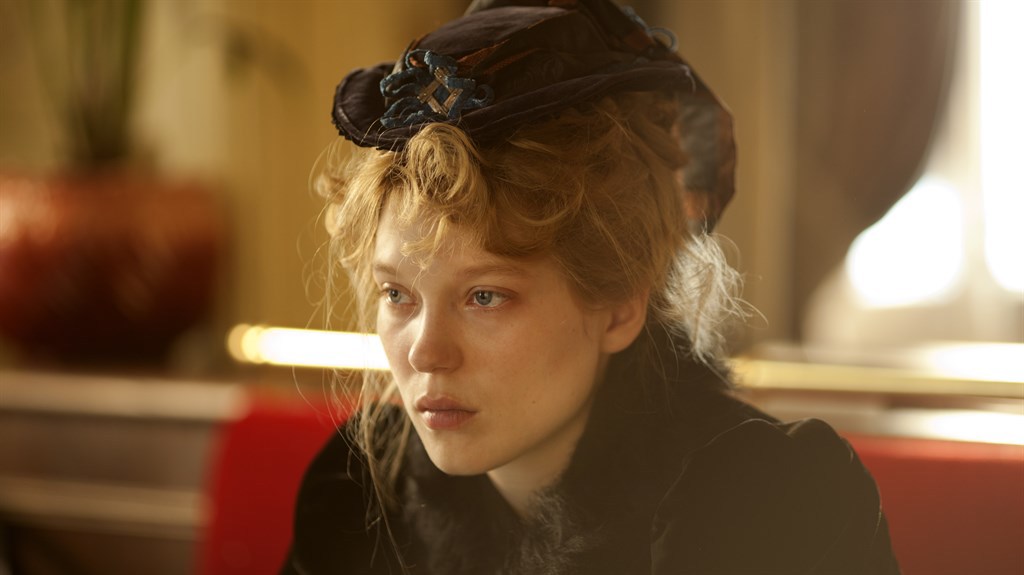
In any case, M. Jacquot, shown at left, has given us a movie in which everything -- from the sets and costumes to the incidents and characterizations -- ring true. In the chambermaid role has been cast one of France's finest and most versatile young actors, Léa Seydoux, who can now add this landmark to her exceedingly diverse resume which ranges from Bond girl to arthouse fave. Ms Seydoux, shown above and below, does not disappoint. She makes her character of Célestine by turns angry, loving, prideful, inquiring, hurt, strong, weak -- and always real.

By the end of this relatively short movie, we understand her perhaps as well as we possibly can (and better, I think, than we understand the Célestines played by Goddard and Moreau). Yes, it's fine to leave something to the imagination and the mysterious, but how wonderful it is to enter the life and mind of a character this completely. Seydoux and Jacquot make it possible.

The supporting cast is crackerjack, as well, with the most unusual work being done by that great French everyman, Vincent Lindon (above and only recently seen in The Measure of a Man). Here, as the groundskeeper, Joseph, Lindon plays a character quite different from his usual -- powerful, frightening, sexual and shockingly anti-Semitic -- as he tilts our Célestine, as well as the movie, toward the dark side,

But, again, Ms Seydoux makes the transition fully understandable, believable and sad. We see her not simply with the stupid and lecherous husband and nasty wife at whose home in the provinces she works, but also, in flashback, at other employ, particularly tending to a tubercular young man (Vincent Lacoste, above, right) who is being cared for by his kindly grandmother. We see her flirting with the prospect of employ at a bordello, and especially in the push-and-pull of a tricky and difficult relationship with her employment agent (very well performed by Dominique Reymond).

With each new situation, we see a new side of Célestine, how she behaves and thinks, and by the finale, all these allow the character to grow and deepen into a kind of progressive reality movies are seldom able to furnish. This chambermaid and her diary should stick with you long after the end credits have rolled.

From Cohen Media Group and running just 95 minutes, the movie opens this Friday in New York City at the Lincoln Plaza Cinema and in Los Angeles at Laemmle's Royal. Click here and scroll down to see all currently scheduled playdates, cities and theaters.
Rate it :

Nicolas Cuche's ANYTHING FOR ALICE: a cute French rom-com with politics and philosophy


If you're looking for something different in rom-coms (and aren't we all, just about all the time), you could do a lot worse that the new one from Rialto Pictures (via the company's more mainstream division), ANYTHING FOR ALICE (Prêt à tout is its original title). Last year Rialto gave us another winning rom-com that offered something a bit different, The Stroller Strategy, and this new one proves a fine follow-up, as it details the budding romance between two college students, a dorky but charming young man and the politically exuberant, beautiful young woman for whom he falls.

As directed by Nicolas Cuche (shown at right) and written by Laurent Turner (The Prey), the latter with some help from Sabrina Amara and Eric Jehelmann, Anything for Alice, like The Stroller Strategy before it, revolves around, among other things, the plight of a single mother, although in this case, our heroine becomes that mother before she meets the man who is so interested in her. What distinguishes this little rom-com, aside from its sprightly nature and good performances, is its interest in the workplace, class distinctions, and the uses of money. The film is particularly funny regarding knee-jerk values and their representation by us humans on the left and the right.

The premise of the film (way over the top) works surprisingly well, too, so far as the fantasy rom-com formula is concerned: that a fellow suddenly come into a lot of money would purchase an entire factory so that his lady love, who works there, might continue to have a job. The would-be couple in question -- the titular Alice and the suddenly wealthy Max -- are played by Max Boublil (above, left) and Aïssa Maïga (above, right), both astute charmers who know their way around the rom-coms tropes.

What this factory produces is a drink called Bang -- a kind of French version of our own Tang, a drink evidently much beloved by Charles De Gaulle. A lot of fun is had about this substance and its manufacture, and you do not have to be French to appreciate it. The movie is also full of surprising and very funny moments -- such as the destruction of a Rolex watch, together with the reason for doing this -- that keep the pace quickening and the laughs coming fast. Once our hero owns the factory, working conditions do indeed change, in ways both good and not so.

Overall, Anything for Alice is a funny and original fantasy of what might happen if you or I, or maybe many of those we know, found ourselves the recipient of just tons of money. In its way, the movie is a kind of twist on the 1940s Hollywood comedy Brewster's Millions, but with all the spending done for a different reason. (In our current "downer" times, Brewster's is a movie ripe for another remake, as the first one pretty much sucked. I wonder why this hasn't yet happened?)

In the supporting cast are a number of fine thespians, but special note must be made of the actress who plays Max's mom, the delightful Chantal Lauby (shown two photos up). Also very good are Max's two best pals (played by Redouanne Harjane, above, left, and Steve Tran, above, right), and a young and promising newcomer,  Idriss Roberson (at right, three photos above), who plays Alice's son, a boy with a bad case of ochlophobia.

You can view Anything for Alice right now, in West Los Angeles at Laemmle's Royal. Elsewhere? I certainly hope so, though I find no other cities scheduled as yet. But maybe the movie will surface soon on DVD and/or digital streaming. If you're a fan of rom-coms-with-smarts, it's very much worth seeing.
Rate it :

Old-time animation from France: Paul Grimault's rediscovered THE KING AND THE MOCKINGBIRD


What a history has this movie! According to the informative press release inviting us critics to a screening, THE KING AND THE MOCKINGBIRD is credited as inspiring the creation of the now world-famous Studio Ghibli, as well as clearly impacting on American animation greats like The Iron Giant. Further history, via that press release, goes thusly: Paul Grimault's animated film, written by Grimault and legendary poet and screenwriter Jacques Prévert (who wrote Children of Paradise, Port of Shadows and Le Jour se Lève), is based on a Hans Christian Andersen story, and has long been considered to be a masterpiece of traditional, hand-drawn, cell animation.

Grimault (shown at right) and Prévert started work on their Mockingbird in 1947, when it was planned to be France's first animated feature. A dispute stopped production, however (we would love to hear the details of that "dispute"), and it was released unfinished by its producer, without Grimault and Prévert's permission. Grimault spent 10 years getting the rights back and another 20 raising the money to finish the film as he and Prévert had envisaged it. It was finally finished and released in 1979, a few weeks after Prévert's death. Though it has been a favorite of French audiences for 35 years, it has long been unavailable in the U.S. due to rights issues. Now, it will finally be released theatrically by Rialto Pictures in a new restoration from Studiocanal, following its U.S. premiere at the New York Film Festival this past October.

So. What kind of film is this? The first thing modern-day viewers used to our current, action-filled, mile-a-minute animated films are advised to do is...  relax, and just go with the flow of this movie's very slow pace. It will take awhile to grow on you, but grow it will. Eventually.

The movie begins with the introduction of its sophisticated, funny narrator, the mockingbird of the title, along with animation that looks remarkably simple. Then we meet the titular King, a narcissistic nincompoop with few peers in all of animation. He's a fellow given, when he is displeased with someone, to pressing a button, after which the floor dissolves under said person's feet -- very James Bond villain-style -- and that person simply drops to their... whatever.

The mockingbird and King are arch enemies, and when, in an instance of fantasy inside further fantasy, two figures from the king's art collection -- a chimney sweep and a shepherdess -- try to escape, first from their respective paintings, and then from the King's thrall, the mockingbird comes to their aid.  The King himself, in fact, soon becomes a fantasy figure, after he escapes from his own painting and presses that button to rid himself of the actual King. (Only the French would come up with a situation this philosophically bizarre.) And then the chase is on.

The kingdom we see here will be especially interesting to art lovers, those with an appreciation of the work of de Chirico, I think: It's architectural landscape, mostly empty of people, and there's a kind of existential creepiness about it. Once we do meet some of the citizenry, they prove strange indeed. Yet the old scenario of class warfare soon becomes apparent, and the use of both wild animals and birds to serve the royalty and the general populace is oddball and appealing.

All of this leads up to what looks like a new kind of French Revolution, building to one of the most resounding final images in the history of animation. Running just 83 minutes, The King and the Mockingbird's U.S. theatrical release begins today, Friday, November 21, as it opens at Film Society of Lincoln Center in New York City, followed by a Los Angeles run at Laemmle' Royal, Playhouse 7 and Noho 7 on December 19, to be followed by a national rollout.

Rate it :

The rich are different in FOXCATCHER, Bennett Miller's look at class, depression & psychosis


How glum is FOXCATCHER, the new movie directed by Bennett Miller (shown below), who earlier gave us Moneyball and Capote? One of the "grayest" movie ever made in color (I don't recall the sun's shining even once, and if you can find a character smiling or happy, do let me know), even when the wrestling champ played by Channing Tatum wins his big match, the sense of dread and doom that hangs over this film is palpable. Granted, the story here -- of the nutcase du Pont heir who took the wrestler under his "wing" and then for good measure took in his older brother as trainer -- is one of the crazier in America's storied history of the damage, personal and societal, that cracked wealth can wreak. No wonder nobody's smiling here.

The screenplay, by E. Max Frye and Dan Futterman, follows pretty closely the news story I recall from the late 1980s, when the events took place. What does not seem to be explored in any depth but is clearly suggested is how the behavior of the rich in our society is pampered, enabled and excused by everyone around them -- from their employees to their peers and even the local police. The results of this are shown here in all their cruddy glory. The rich, in this case, are personified by Jean du Pont (Vanessa Redgrave) and her son John (Steve Carell, shown below), and both actors do what they can by the fairly proscribed roles that allow them mostly a single note: in Ms Redgrave's case, it's rich/restrained, in Mr. Carell's it's rich/nutty.

Much has been made of Carell's hugely changed facial appearance via a prosthetic nose, and if the Academy follows its usual path of honoring prosthetics over performance (Monster and The Hours are two examples), we might see an Award in sight once again. (Carell, a fine and versatile actor, does everything he can with his role, but the screenplay's lack of exploration of his character (beyond a rich momma's boy) leaves him somewhat stymied.

Mr. Tatum, above, adds another feather to his growing cap of fine performances. He's definitely the saddest character on view, with no life to speak of except his sport: he's got a bleak history and probably an even bleaker future. Times were perhaps a bit better back in the 80s than they are now, but in any case depression seems to reign over all.

The most "normal" character in the film would be older brother Dave, played by Mark Ruffalo (above). A family man who loves and honors his brother, and then tries to do the same for du Pont, Ruffalo's Dave captures the innate kindness of the man, as well as his physical abilities and skill in training. (The wrestling scenes here register as pretty authentic.)

Foxcatcher (the title comes from the name of the DuPont farm, later doubles as the name of the Olympic training ground the farm becomes) is a mostly male movie; the only women we see much of are Redgrave's closed-off mother and Dave's wife (played by Sienna Miller, above), who is also shown to be unhappy most of the time. Bleakness even hangs over the few scenes of family fun that Dave, his wife and kids engage in.

I can appreciate Miller's and his screenwriters' aim to give us a kind of peculiarly American tragedy in the making, but I wonder if their constant insistence on the glum does not begin to make the film feel too manipulative. Even into the bleakest of lives a little joy sometimes falls, but you'd never know that from what we see here. Never uninteresting, though a certain sameness does eventually sink in, Foxcatcher is definitely worth seeing. Some of the Hosannas we've been hearing, however, seem a tad out of place.

From Sony Pictures Classics and running a lengthy 134 minutes, Foxcatcher opens this Friday in Los Angeles (at the Arclight Hollywood, AMC Century City 15 and The Landmark) and New York City (at the Regal EWalk 13, AMC Lincoln Square and the Landmark Sunshine), and will open nationwide in the weeks to come. To see all currently scheduled playdates with cities and theaters, click here and scroll down.
Rate it :
 

Find us on facebook

TOP
Copyright © 2014. Movies & TV Stream - All Rights Reserved
Template Created by ThemeXpose- Published By Gooyaabi Templates