Comments

recent
Latest Movie :
Recent Movies
View As:
Showing posts with label Austrian cinema. Show all posts

Beauty in desolation: Nikolaus Geyrhalter's exquisite photographic study, HOMO SAPIENS


Our species appears nowhere in Nikolaus Geyrhalter's brilliant and breathtakingly beautiful, if ironically titled documentary, HOMO SAPIENS, yet our mark is all over the place. In this, the latest film from Herr Geyrhalter, who has already given us a couple of whoppingly good docs -- Our Daily Bread and Abenland -- the Austrian filmmaker who conceived, directed and shot this stunning piece of work (with the prodigious help of Simon Graf in scouting the amazing locations used here) has compiled a series of what could almost be -- were it not for the occasional wind, waves and birds -- still-life photography of empty, desolate but stunning exteriors, interiors and sometimes a combo of the two in which nature seems to be re-enforcing her domain on ours.

The filmmaker, pictured at right, lets his camera remain stationary as it gazes at scene after scene, location after location, for anywhere from 15 to 30-or-more seconds. This gives the viewer ample time to take it all in. And how very much there is to take. Geyrhalter is an artist. His compositions are wonderful: rich and detailed, forcing us to observe closely, think about what we're seeing, then make all kinds of connections.
We go from a gorgeous, decrepit amphitheatre to a deserted (for quite some length of time, it seems) railway station and shopping mall (in Japan, perhaps? The writing we see would indicate somewhere Asian) to an auditorium or two, hospitals, even a roller coaster seemingly positioned in the sea. The locations are bizarre and amazing, and the cinematography is, too. Yet it is not simply beautiful (that might very well be enough), it is also about as artful and thoughtful as photography can get.

There is no dialog here, no sound save the ambient ones: wind, gulls cawing, pigeons cooing, Music? You know, I cannot now remember. The movie was that hypnotic. But yet I never felt sleepy in the least. I would imagine that photography buffs will make a bee line for the documentary, which opens this week in New York City at Anthology Film Archives.

Although there is great beauty here (and Geyrhalter seems incapable of not zeroing in on it with simplicity, always capturing the right composition, angle and even color (or lack of it). He finds his beauty in desolation, and this is the way in which he gets us to considering what homo sapiens have to do with all this. How did the hospital room (above) come into such disrepair, for example? Was that empty shopping mall too near Fukushima? (One of these malls may be closer to the USA, as it bears the name Woodville.)

A house of religion is just as likely to have emptied out as has the mall. Or a prison. Or an office, below, full of aged computers. For me the most beautiful shots of all seems to have been taken in an empty planetarium. Even a greenhouse has gone to seed. The movie offers its own special pacing and an odd kind of momentum. There's dark humor, too: in the loudspeakers atop poles wrapped in vines (or in the winter, snow). Interestingly, the shots taken in the desert seem not as memorable as the others (the desert is already desolate, right?). Ditto the wintertime scenes, where snow can more easily mask the desolation.

And then we've come full circle, back to that original amphitheater. What a journey! Perhaps I missed them, but I tried to check the credits for a listing of locations where the movie was filmed. I am pretty sure Japan, Germany (or Austria) and the USA are among them -- and maybe other countries, too. Whatever, Herr Geyrhalter has graced us with one wonderful documentary that photo buffs will eventually want to own on disc. Unless some enterprising publisher thinks to put out the coffee-table book version.

From KimStim and running 94 minutes (TrustMovies could have watched another hour of it, at least), Homo Sapiens opens this Friday, July 29, at Anthology Film Archives in New York City for a week's run. Elsewhere? There's is nothing as yet on the KimStim site to indicate further showings. But I would hope an eventual DVD or Blu-ray is in the offing.
Rate it :

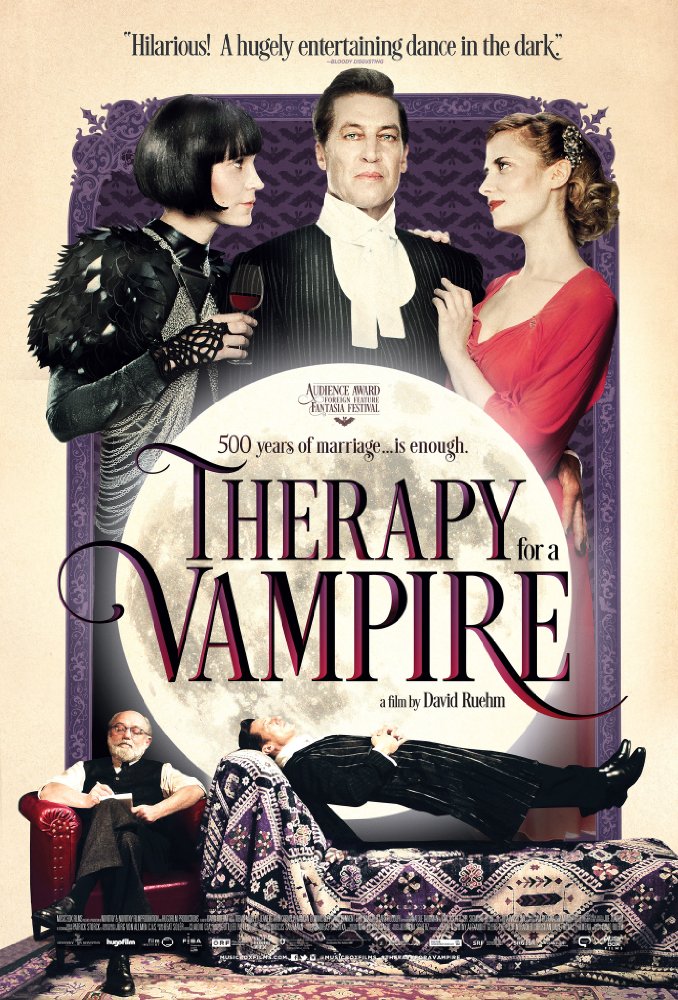
Fun with the fanged undead in David Rühm's chuckle-worthy THERAPY FOR A VAMPIRE


Genuine scares and originality are in such short supply these days regarding zombie and vampire movies that we mostly must rely on humorous riffs on these genres to bring us decent entertainment. Zombies don't lend themselves much to humor (though you might want to try the very funny, clever and low-budget Stalled), but vampires, being a lot more versatile than zombies, do occasionally provide some fun (witness last year's New Zealand mockdoc miracle, What We Do in the Shadows).

Now comes the latest bit of very funny nonsense regarding these particular undead, and it's a little ditty from Austria/Switzerland -- in German with English subtitles -- called THERAPY FOR A VAMPIRE. This particular Count (not Dracula, but one, Geza von Közsnöm) has been married now for some 500 years and is growing bored with this lengthy state of matrimony. Writer/director David Rühm, shown at right, has cobbled together a short, swift, full-of-laughs riff on many of the vampire themes and lore that we vamp-lovers have come to appreciate. His "take" on it all proves charming and refreshingly light on its feet.

The very idea of a vampire needing therapy due to marital problems is clever enough, and while Herr Rühm makes some fun out of Sigmund Freud's encounter with our Count (Karl Fisher -- above, left -- does a fine job as our famous "first shrink"), the most sustained laughter in the film comes from the way in which the filmmaker deals with vampire habits like flying, climbing walls, and not being able to reflect in mirrors.

The last of these characteristics is responsible for the appearance of our vampire Count's wife (Jeanette Hain, above, right) at the door of a talented young artist (Dominic Oley, above, left), whom she needs to paint her portrait (since she can't see herself in any of her mansion's many mirrors).

The Count, meanwhile (a lovely and humorous faux-Drac rendition by Tobias Moretti, above), has become smitten with the artist's girlfriend, Lucy (Cornelia Ivancan, below, left), who quite resembles his old girlfriend who, thousands of years ago, turned him into the bloodsucker he remains.

The rondelay in which these four indulge keeps the plot ticking, but it is how certain characters react to their newly acquired -- and then, oh, no! loss of -- vampire skills that makes the movie so much fun. These moments are as oddly "real" as they are enchanting and hilarious, and they'll keep that grin across your face for most of the movie's 87-minute running time.

The requisite blood and gore? Oh, it's there, all right, but it's done with short, sharp and relatively subtle bravura, so that we get the point while also getting the humour/satire implicit. Meanwhile, themes of identity, feminism and vampirism all get their due, too, and we finish the film with that satisfied smile still on our faces.

Therapy for a Vampire, from Music Box Films, opens this Friday, June 10, in Los Angeles at the Landmark NuArt and in New York City at the Landmark Sunshine Cinema, and then, in the weeks following, hits another 15 cities around the country. To see all currently scheduled playdates, click here and then click on THEATERS on the task bar midway down the screen.
Rate it :
 

Find us on facebook

TOP
Copyright © 2014. Movies & TV Stream - All Rights Reserved
Template Created by ThemeXpose- Published By Gooyaabi Templates