Comments

recent
Latest Movie :
Recent Movies
View As:
Showing posts with label documentaries. Show all posts

Israel/Palestine via a different, personal lens in Daum/Rudavsky's doc, THE RUINS OF LIFTA


The question of land, ownership, history and all that goes with is always problematic, no matter the location. But when the location is Palestine and Israel, this subject seems very nearly intractable. Over the years there have been a number of fine documentaries and narrative films that have tried to disentangle things -- Colliding Dreams and Rabin: The Last Day are two films that have arrived already this year -- and now we have a very small and very personal little movie that tackles the issue via one single location, Lifta, the only Palestinian village abandoned during the 1948 Arab-Israel war that has not yet been destroyed or repopulated by Jews.

As conceived and directed by Menachem Daum, (shown at left on the poster, top), who appears prominently in the doc, and Oren Rudavsky (shown at right, who co-directed Colliding Dreams and, with Mr. Daum, the excellent post-Holocaust-in-Poland doc, Hiding and Seeking), the movie tracks the obsession of two men with this small abandoned village. Over the years, Mr. Daum has become increasingly concerned about Lifta because its actual story goes against much that he, as a Jew, had been taught by his elders and family about what happened there and why.

The other man, Yacoub (at right on poster, top), was a resident of Lifta who, with his family, was expelled from their home and village during the Nakba (the exodus of more than 700,000 Palestinians who were forced from or fled their homes and villages during the 1948 war).

As Mr. Daum, above, was born in a displaced persons camp in Germany to Jewish parents who had survived the Holocaust, we have a near-perfect combination of people who have suffered enormous displacement and feel powerful attachment to the same homeland. Can there be some kind of rapport and rapprochement to be made here?

Add to the mix an actual Holocaust survivor still remaining alive, an old New York woman named Dasha (shown center, above), one of the few Jewish friends of Menachem who understands his feelings about Lifta. Eventually, Dasha agrees to travel -- at her age! -- to Lifta to meet and speak with Yacoub. The resulting meeting is fraught and difficult, and seeing and hearing these thoughts and feelings pour out is rather extraordinary. Yes, this is but one example involving only two, three people, but this scene -- in fact, this entire movie, gets at the very core of the Israel/Palestine conflict.

The state of Israel is planning to turn Lifta into a real estate development for luxury housing (and not, I think, for Arabs), but protesters (above), both Arab and Israeli, are trying to save the land, with the hope of turning it into a UNESCO World Heritage site. But this would depend on approval by the Israeli government. We watch as meetings toward this goal take place, and we see Mr Daum interview various officials and citizens about the project. -- which is no shoo-in, for sure.

Don't look for resolution. There is none here. But we understand, more deeply and fully, the ideas and feelings on both sides. So we've come a step closer, at least, in this -- one of the smallest and most personal of the many Israeli/Palestinian documentaries to have been released. Also one of the most successful.

Distributed by First Run Features and lasting only 73 minutes -- the movie needs no more time to make its points -- The Ruins of Lifta opened at a single New York screen (the Lincoln Plaza Cinema) yesterday, September 23, and will arrive next month on October 28 in Los Angeles at Laemmle's Town Center 5.

Elsewhere? Nothing yet. But click here to keep up with any further scheduled playdates, cities and theaters.


New York City 
personal appearances! 

On Saturday: 
a Q&A after the 
7:15 & 9:20 pm screenings, 
with the Co-director, Oren Rudavsky, 

and on Sunday: a Q&A 
after the 3:00 pm & 5:05 pm screenings 
with Co-directors Oren Rudavsky & Menachem Daum 


Rate it :

A North Korea we've never seen -- in Cannan & Adam's fun doc, THE LOVERS AND THE DESPOT


How strange that the most enjoyable (and bizarre) film about North Korea so far -- and this would include even The Interview -- would be a documentary that pairs North Korean dictator Kim Jong-il with a South Korea film director and his actress wife that the little dictator first has kidnapped and then "persuades" to make movies up north instead of down south. THE LOVERS AND THE DESPOT takes us back to the 1970s and 80s, while giving us a view of Kim Jong-il that is not quite like anything we've heard or seen.

Granted, as viewed in this dishy and often delightful documentary directed by Rob Cannan (shown below) and Ross Adam (shown at left), little Jong-il comes off nothing much like the man his better (or was it worse?) father, Kim Il-sung, but maybe slightly better (worse?) than his own son, successor and current ruler, Kim Jong-un. Because what we outsiders can learn and understand about this little country that has for decades been shrouded in secrecy remains so paltry -- also so uncertain:
how do we know much of anything we hear is even true? -- North Korea has taken on something of a mystical nature in our minds. It's weird and awful, of course, but -- come on now -- it's kind of fascinating, too. And because most docs we've so far seen about this country have had their filmmaker's access restrained to the point of why bother? -- while the one narrative movie to tackle the subject, The Interview, proved much more successful as a satire of the American media and our drive for success at any cost than of North Korea itself -- The Lovers and the Despot immediately takes its place at the forefront of reality, despite its pretty loony-tunes content.

To get  right to it, that content tells the tale of a Kim Jong-il so besotted with love of movies -- and of the Hollywood and South Korean variety, rather than that of his stodgy, home-grown product -- that he (or maybe someone on his staff) comes up with the idea of kidnapping South Korea's leading actress, Choi Eun-hee (pictured above, in one of her roles) and maybe getting her to make movies for him.

Ms Choi had been married to one of South Korea's leading filmmakers, Shin Sang-ok (above), though the two, I think, were already divorced by now (turns out that Mr. Shin was an unfaithful hubby), and the couple had two adopted children (whom we see and hear from throughout the doc). Shin, bereft at the loss of his leading lady (and maybe still his love), gets depressed and can't find work at home, so when rumors arise of this possible North Korean kidnapping of Choi, he somehow arranges for himself to be "kidnapped," too, so he can join his woman.

Initially, Ms Choi is kept under a kind of easy-going house arrest, with periodic meetings with dictator Kim, while Mr Shin is shoved into a real prison and spends several years there. Eventually the little dictator reunites the pair, apologizes for their previous and not-so-hot circumstances, and the creative duo begin making movies for him. When these films becomes successful enough to find their way into film festivals in the east and finally the west, escape seems like a real possibility,

We see all this via what look like surprisingly well-done re-enactments that adhere to the look and feel of the the time period (grainy film stock, in-period fashions, cars and the like). Much of the North Korean footage could easily be real, taken by the folk who did the kidnapping (Kim and his henchmen seems very camera-oriented). Verbally, we get much of our remembrances from Ms Choi and her two children, as well as from a few "critics" of that day, and finally from some of the folk involved with the western powers. (Yes, the U.S, was part of all of this, too. Aren't we always?). Mr. Shin, for reasons we later learn, is not present verbally.

Turns out that, while credence is generally given to Ms Choi's story, disbelief is mostly the case where Shin is concerned. Whether he was kidnapped or "defected" is still up for grabs in both South Korea and in the west. (And yet his defection, after all, would have been in search of his wife.) All told, what we see and hear here makes about as much sense as anything else to come out the blinkered and hidden world of North Korea. Interestingly, what takes place in the old North Korean footage in this film often mimics what we've seen in other recent docs (such as Under the Sun and Songs From the North) about this hidden little country: parades, awards, ballet classes, and the ever-conforming populace involved in group displays of pride, joy or grief when the dictator dies. (We're told here that, if one's grief did not seem real enough, one could be "disappeared.") All of which underscores the sense that nothing -- not now, not then -- comes out of North Korea that is not micro-managed.

The most fascinating piece of this new doc is the look we get at Kim Jong-il, who, for all the horror that he, his dad and his son have inflicted on this sad country, would seem to be a fellow who genuinely loved movies and was affected/afflicted by them. Under his hand, Shin and Choi made some 17 features films, including the first actual love story to come from North Korea. (Shin remarks at some point about how wonderful it is not to have any more "money problems" while directing a movie. Take that, Capitalism!) These three had what appears to be a "real" relationship, so one also wonders about the betrayal, even sadness, Kim must have felt when his prize possessions suddenly hi-tailed it back to the south.

A United Kingdom production, released in the U.S, via Magnolia Pictures, The Lovers and the Despot -- in Korean, Japanese and English, with English subtitles when needed -- runs 98 minutes. It opens this Friday, September 23, in New York City, Washington DC, the Los Angeles area, Boston, and Philadephia, with further expansion across the country in the weeks to come. Click here and then click on GET TICKETS to see all currently scheduled playdates, with cities and theaters listed. 
Rate it :

Oh, granny! Tom Fassaert's Dutch doc about his problemed relatives, A FAMILY AFFAIR


So much is made these days about the often "tenuous" link between truth and whatever new documentary is currently under the critical microscope -- see Nuts, Cameraperson and Kate Plays Christine for three prime examples: two excellent, the other not so -- that when an old-fashioned, point-your-camera-and-try-to-get-the-whole-story appears, it almost seems fresh and unique. Such is the case with A FAMILY AFFAIR, in which Dutch filmmaker Tom Fassaert attempts to get his paternal grandmother, Marianne, who now lives in South Africa and has reached the ripe old age of 95, to come clean about the past.

Mr. Fassaert, shown at right, dispenses with anything "meta" or even much that is discursive. And don't look for clever animation to help fill the time and increase your enjoyment. The filmmaker explains at the opening what he is after and why, and then he simply goes for it. But since what he is going for is the deep secret that appears to be hiding within that grandmother, you can expect to enter a certain very dark region known as "family." When Mr. Fassaert's father was just a young boy, his mother, Marianne, placed him and his brother in a children's home, occasionally visiting them but in reality more-or-less abandoning her two children.

Both grew up highly problemed. Tom's father (shown above with his mother in later years) worked around those problems as best he could, providing a home and a help to his son, Tom. Tom's uncle, dad's brother René, was not so lucky and remains, to this day somewhat mentally at sea. Down the years, the relationship between Tom's dad and Tom's grandmother has remained rocky -- very off and on, stop and start.

So when Tom receives a request from his grandmother to come and visit her in South Africa, he jumps at the chance, turning on his camera almost immediately. Family albums -- in both Holland and South Africa -- are unearthed and combed through (granny was a fashion model back in the day) and the camera stays on grandmother as much as possible with occasional forays into dad and René and a few even farther outliers.

It does not take long, however, before Tom (and we viewers) realize that his granny (below, in her glamor curlers) is not going to be forthcoming on her own. She won't be forced to reveal the past, and so she'll have to somehow be cajoled. "The truth is subjective," she tells us early on. "You'll never find what you're looking for, even if you try." A near-complete narcissist who lives only to look good, granny is a piece of work you won't easily forget.

The more we learn about her and the history of Tom's family, the more awful the woman appears to be. There's a will (and the changing of inheritors), and an autobiography to be written (with a change in the ghost writer along the way). Grandma would rather flirt with her grandson than give up those secrets easily, and so the film, too, takes its sweet time. Yet it is never boring because we keep learning new bits and pieces, while seeing grandmother and her two sons more fully.

Finally, you might even find yourself with a kind feeling or two for granny (though these hardly outweigh the damage this thoughtless, selfish woman has done). The press release for the film promises a big "reveal," which turns out to be, in our current times, something relatively minor.

By the film's end, though, we've been shocked and moved and made to once again understand how difficult it is to get to the bottom of things. And yet Mr. Fassaert has managed to do his job in a way that seems about as honest and truthful as possible. He probes, gently and then more forcefully, but backs off when he must. Personal and painful, the movie goes about as far as it can.

The secret at the center of it all -- how could you do this to your children, and why? -- is never fully answered. The mystery of "family" remains just that. But once again, as with all good documentaries on this subject, the door has been opened a crack wider and we've seen something special and different, enticing and disturbing, that we can now add to that memory book of oddball families we have known.  Some of us might also realize that our own family could easily be included, too, even as we feel gratitude that ours is not nearly as oddball as what we've seen here. (That's Tom, above, in his somewhat younger days.)

A Family Affair -- supposedly released via Abramorama (but good luck trying to find the film on its web site), spoken in Dutch and English with English subtitles -- opens tomorrow, Friday. September 16, in Los Angeles (at Laemmle's Music Hall) and New York City (at the Cinema Village). Elsewhere? Don't know, but one hopes to see this doc make its DVD and/or digital debut soon.
Rate it :

September Sunday Corner With Lee Liberman: WHAT OUR FATHERS DID: A NAZI LEGACY -- two Nazi sons and a Jew burdened by history


The writer and co-producer of this odd holocaust film, available now on DVD and via Netflix streaming, is a most accomplished fellow -- Philippe Sands, international human rights lawyer, law professor, prolific author, the latest work of which is: East West Street: On the origins of Genocide and Crimes Against Humanity.

Published in May 2016 to a torrent of praise (press title, above, for review) it contains the material that led to our film plus the stories of two Nuremberg prosecutors whose work created the basis for the prosecution of war criminals.

The film itself,  WHAT OUR FATHERS DID: A NAZI LEGACY (2015), has won top prizes at several film festivals and a British film award. It is thus with ambivalence that I quarrel with it because Sands's body of work is completely admirable and the film is engrossing and thought-provoking.

Directed by Sands's friend, David Evans (of Downton Abbey, above), it begins as the story of Niklas Frank and Horst von Wachter, whose two highly placed Nazi fathers, Hans Frank and Otto von Wachter, executed the entire Jewish population under their jurisdiction in Poland and Ukraine. The film morphs into a warm yet toxic relationship among the three men -- Wachter, Sands, Frank (l - r, below).

The viewer goes along as the world and crimes of the two fathers are revealed until the viewer begins to feel unwillingly drawn into the relentless, emotional "right-fight" (I'm entirely right; you're entirely wrong) that escalates pitting Sands and Niklas against Horst. (One columnist wrote that the film should have been titled "Making Horst Crack".)

Sands is painfully connected to his subjects: his paternal grandfather was the sole survivor of a family of 80 Jews from western Ukraine murdered by the two senior Nazis. Hans Frank was Hitler's personal lawyer and appointed governor of occupied Poland; he turned it into a killing field. Frank's mandates were carried out by Otto von Wachter -- an Austrian lawyer who served as civil administrator of Krakow and Galicia (Ukraine). (Below, front row, Frank, l, with Hitler.)

We learn through Sands's interviews with each son (both born in 1939 and now nearing 80) that Hans Frank and his wife were cold, estranged parents. Niklas learned kindness from his nurse; he matured clear-eyed about the crimes of his father having already been primed by the indifference of both parents. He described his father once as 'a slime-hole of a Hitler fanatic' ; his book, Der Vater (1987) was a controversial bestseller in Germany -- said to have been the first time a child of a high-ranking Nazi broke the silence of Nazi descendants.

Horst, on the other hand, grew up in a loving family (above). "I know that the whole system was criminal and that he was part of it, but I don't think he was criminal....." he says. Horst claims his father believed and even told Hitler that his racial policies could not endure. Otto's views appeared to have concerned his superiors enough for Heinrich Himmler to have offered him the option to change posts; dutiful Otto stayed on the job and carried out Hans Frank's extermination directive. Hans was executed following the Nuremberg trials. Otto fled, taking refuge in the Vatican and dying of illness at 49 while under its protection.

At the overgrown killing field where his relatives were executed and their bones remain (above), Sands confronts Horst with his father's 1942 signed paperwork and continues to press Horst to admit his father's guilt. Niklas joins in and all three grow obstinate. Frank and von Wachter both had command authority over the mass murder but Horst remains mealy-mouthed -- his father was not evil. Niklas declares that Horst is a Nazi at heart and renounces their friendship from childhood (below, an almost proud Niklas with photo of his executed father).

The film reveals that Horst chose not to follow the professional path for which he was groomed. Refusing to go to law school, he found employment as an assistant to a Jewish artist, assuaging his soul, at least, that his daily life served as protest against anti-Semitism. Horst retains an empathic view of Judiasm but no matter the evidence, cannot bring himself to condemn his father.

It's too easy to condemn Horst for being in denial of his father's guilt and to applaud Niklas's clarity about his father's crimes -- it means none of the familial ties or the environmental conditioning have been factored in, such as the coldness of the Franks that led a son to hate a father nor the relent-less pressure of conformity by the Nazi culture that carried Otto in its tide.

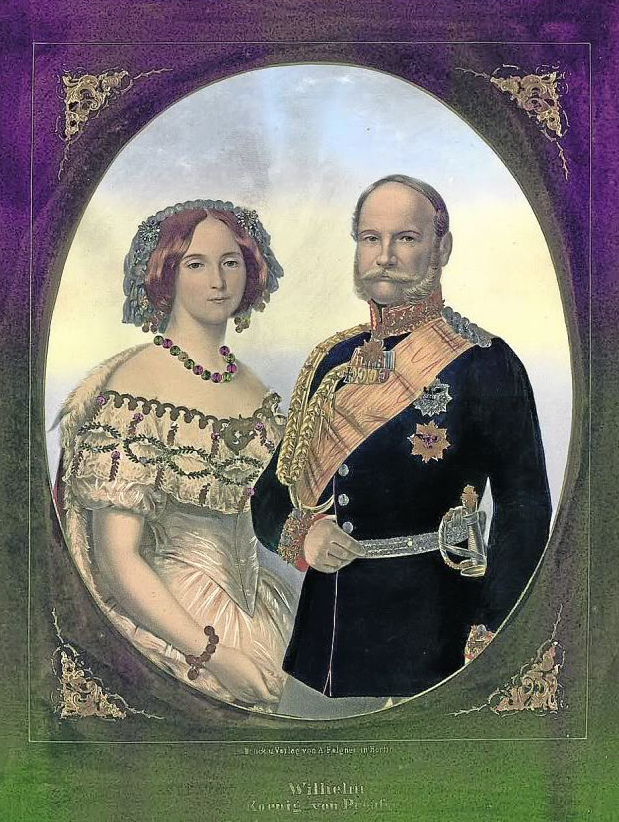
The mindset that was to govern Germany originated in a Prussian Calvinism practiced by Wilhelm I (1797-1888) King of Prussia, ('the soldier king,' with his wife Augusta, at right), the first German head of state of a united Germany (Prussia was a territory/ kingdom that combined with others to form the German empire). "Soldatic virtues" included duty, discipline, subordination, loyalty. Prussian men were instilled with a range of strictures that were to infiltrate the character of a united Germany. And when Hitler came to power in 1933, education and public opinion were commandeered entirely; the force of Nazism suppressed or replaced the individuality, empathy, and objectivity required for public opposition.

In a recent interview with the aged (105) secretary of Joseph Geobbels, Brunhilde Pomsel, she describes herself as a product of Prussian discipline and sense of duty: "... After the rise of the Nazi party, the whole country was as if under a kind of spell...the idealism of youth might easily have led to you having your neck broken." In effect, for an individual to oppose Nazism went against the human instinct to seek safety and protection in the prevailing wind. Humans bond together for survival.

Philippe Sands, his family having been murdered by the two fathers, is an understandably emotionally-fraught narrator as he presses Horst, the troubled, guilt-ridden older man, to 'crack' -- not Sands's finest moment. Oddly, at least one virtue of this film is in its revelation of myopia that freezes belief like a dragonfly fixed in amber.


The above post was written by our 
monthly correspondent, Lee Liberman.
Rate it :

Werner Herzog's look at the Internet age: LO AND BEHOLD, Reveries of the Connected World


As someone who runs hot (Into the Abyss) to lukewarm (Cave of Forgotten Dreams) regarding the work of Werner Herzog, TrustMovies would call his new documentary, LO AND BEHOLD, Reveries of the Connected World, one of his better endeavors. In it, this peripatetic filmmaker, whose interests seem to be about as vast as our universe, concentrates on some of the ways our world has changed and continues to change thanks (and sometimes not) to the impact of the Internet.

Herr Herzog, shown at right, is present here, as so often, not only in the visuals he's chosen to shoot but in the interviewing and narration he supplies. He questions his subjects but lets them go on into whatever tangents might interest them (and him, and us). He has divided his doc into something like ten chapters, beginning with The Early Days -- in which he gives us the chance to meet and enjoy web pioneer Ted Nelson, whose remembrance as a child of the way water worked around his fingers is quite lovely and profound -- to his final chapter, The Future, in which he notes how all our movies and TV shows got the future so wrong. No flying cars, space travel or aliens -- but something nobody quite managed to imagine back then: the Internet!

It's this kind of notion -- charming, surprising, observant and wry -- in which Herzog excels. In between the beginning and end of his new film, the filmmaker covers all kinds of odd and interesting stuff. One chapter is devoted to the dark side of the Internet, with one particular family and their terrible history shown front and center.

We also see and wonder at people today who can (sometimes must) avoid the Net: those allergic to cell phone towers and frequencies. We are made privy to what might be the end of the Net, as well (solar flairs, anyone?). We meet some smart hackers (Kevin Mitnik is one of these), hear and see Elon Musk talk about possible life on Mars (his view is thoroughly demolished by one smart woman), meet some intelligent robots and watch them work, and even hear from the man who invented the self-driving car.

It's all thoughtful and fun and occasionally scary and moving, too. Overall, this is one of Herzog's loveliest, most discursive (in a good way) and far-reaching works.

From Magnolia Pictures and running a just-about-right 98 minutes, the movie opens all across the country on Friday, August 19. In New York City, look for it at the Elinor Bunin Munroe Film Center; in Los Angeles at Landmark's NuArt, and here in South Florida at the Bill Cosford Cinema in Coral Gables and the Lake Worth Playhouse in Lake Worth. To see all currently scheduled playdates, with cities and t heaters listed, click here.
Rate it :

Fashion, Hollywood and Homosexuality in Gillian Armstong's WOMEN HE'S UNDRESSED


If the name Orry-Kelly means nothing to you, you're either young, straight, or simply uninterested in the heyday of Hollywood and its famous fashion designers. TrustMovies has never been all that interested in fashion (he often quite literally loathes it), but he is bi- and has had a hard-on for Hollywood since around the age of two (when he ran away from home and off to a "picture show," as he then called the movies). Although he didn't realize it until he saw the film under consideration here, he's also been a huge fan of Orry-Kelly's work. Those memorable gowns from Les Girls, above, are in fact long-time favorites of his (the movie may be second-rate, but its fashions are absolutely first-).

The new documentary about Orry-Kelly, WOMEN HE'S UNDRESSED has been directed by Gillian Armstrong (shown above, at right, with multi-Oscar-winning costume designer Catherine Martin) and written by Katherine Thomson, both of them Australian, as was Orry-Kelly himself (who, for purposes of space and repetition, will henceforth be referred to as O-K). What these two have given us is really a kind of celebration of O-K: his life, work, sexuality and in particular his ability to live a relatively uncloseted life in tinseltown long before many other gay men cared to and/or were able to do anything like this.

Incredible as it seems, O-K costumed some 301 movies between the years of 1930 and 1963. And many of these were amazing, pivotal works whose costumes were vital to the films, and, as one of the many fascinating interviewees points out, they look as good, and almost as "modern," today as they did back then. O-K clothed some of Hollywood biggest stars -- from Bette Davis and Rosalind Russell to Marilyn Monroe and Shirley MacLaine -- and most of them loved him and his work. One of the joys of this lovely documentary is how well it makes us understand what and how the designer was doing, why it was important and especially why it worked so well. You'll come away from the movie with a new (maybe renewed) sense of the importance of fashion to films.

The movie also captures this Hollywood era in spades, with particular emphasis on what it was like to be gay in Hollywood from the 30s into the 50s and early 60s (O-K died in 1964). We get a good sense of the man's history, and the filmmakers choose to do this via some charming and intelligent re-enactments using actors in the roles of O-K (a sly, sweet job by Darren Gilshenan, above, as the adult O-K, and Louis Alexander, below, as the younger version),  his mother (Deborah Kennedy), and even briefly his first and perhaps greatest love, a fellow named Archie Leach (known to you all as Cary Grant and played in this film by Nathaniel Middleton).

Based in good part on O-K's unpublished memoirs -- which, according to Wikipedia, were discovered in the care of a relative after the man's death -- the film does full justice to the designer's humor, panache, style and wit, regarding both his work and his attitudes. I suspect he would be pretty damned pleased with this funny and charming documentary -- in which some very good and still-living costume designers, along with actors like Jane Fonda, who worked with the man a few times in her early career, talk about him fondly and with great appreciation.

Ms Armstrong, whom many of you still remember for My Brilliant Career) does a fine job of keeping all this moving and snappy so that interest does not lag for a moment. And her interweaving of the reenactments with historical footage and scenes from various film makes her documentary non-stop eye-opening and appealing.

The movie is a fine appreciation of a man and his time in a town that was anything but welcoming of his kind -- and yet in which he managed to make a place and a name for himself. This is a wonderful story, and -- despite a couple of odd fact mistakes -- I am so glad we are now able to see it. (That's a photo of the real Orry-Kelly, at left.)

From Wolf Releasing and running 99 minutes, Women He's Undressed opens tomorrow, Friday, July 29, in Los Angeles at the Arena Cinema for a week's run, after which it hits home video on Tuesday, August 9 -- for purchase or rental.
Rate it :
 

Find us on facebook

TOP
Copyright © 2014. Movies & TV Stream - All Rights Reserved
Template Created by ThemeXpose- Published By Gooyaabi Templates