Comments

recent
Latest Movie :
Recent Movies
View As:
Showing posts with label Israeli cinema. Show all posts

Elite Zexer's Sundance winner and Ophir-nominated SAND STORM opens at Film Forum


An Israeli film that's all about Bedouins, their traditions and halting attempts at some kind of modernity, SAND STORM is original, exotic, fiery and humane -- often simultaneously. What we see happening has the air of something centuries old, even if the plot pivots on how a daughter's cell phone is coincidentally answered by her mother. Taking place mostly in the home of a family in a tribal village in Israel's Negev desert, the film centers on that mother and daughter, both of whom are chaffing at the bit of Bedouin patriarchy.

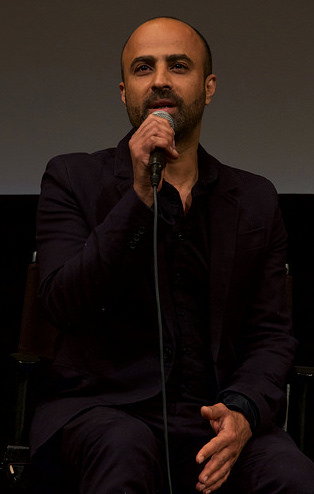
Part of the movie's surprise and fascination comes from the fact that it seems very different from so much else we've seen come out of Israel -- narrative- or documentary-wise. As written and directed by a filmmaker new to me, Elite Zexer, shown at left, it immediately tosses us in media res and then let us fend for ourselves in figuring out what is happening and why. We do, and pretty quickly, although I suspect folk who live in this part of the world may have a stronger connection to the traditions and mores of the characters we see.

The mother of the family (Ruba Blal, above) is having to prepare, most unhappily, for her husband's wedding to a new wife, while her daughter (Lamis Ammar, below, right), we soon learn, is carrying on a forbidden romance with one of her university peers (Jalal Masarwa, below, left).

Dad (Haitham Omari, below, right) is a handsome but ineffectual man, who, as his wife and daughter both point out, is constantly explaining his actions by saying that these are things he "has to do." Everybody here -- women and men alike -- appear to be abused by their own traditions and the patriarchy, though the women, as ever, have it worst. We get the sense that education is the force that is helping to unite Bedouins, and yet this unity, which has brought together the daughter and her boyfriend, is also what is creating out-of-tribe relationships -- a no-no in this culture.

Love vs arranged marriage, family ties vs tribal ties, banishment and sacrifice -- all of this pits mother against daughter against father, with escalation heaped upon escalation. When, toward the finale, one character tells another, "There's nothing for you here," we realize that this judgment could apply to literally everyone on view.

Sand Storm could be an unrelentingly sad and difficult movie, but Ms Zexer fills it with such marvelous actors and has given them a screenplay that goes just far enough to fill the audience's understanding without over-explaining anything. The film's final scene, in fact, is completely silent. But it is hugely meaningful, presaging unfortunately what may come for the next generation.

In what may be be the movie's most telling moment, dad's plump and pretty new bride, above and below, implies to the daughter that her own situation as the newbie here is nothing to be pleased about. We never learn the details, but it becomes suddenly clear that there is probably "nothing for her here," either.

This "I have to" attitude, expressed by dad but also by so many other characters in their own way, is what allows -- and disallows -- so much that has and will continue to happen.  The movie is certainly feminist and anti-patriarchy, but it lets us see how these traditions -- large and small -- suppress everyone on view. At the wedding ceremony, for instance, certain women (I am guessing they are the former and now-tossed-away wives) must wear fake mustaches. Gheesh.

It is no surprise that this film won the World Cinema Grand Jury Prize at this year's Sundance Fest, and that it was also nominated for twelve -- count 'em -- Ophirs (the Israel's equivalent to our "Oscar"). Because it won six of those, including Best Director and Best Film, Sand Storm becomes automatically designated as Israel’s official submission to the Oscars for Best Foreign Language Film. It is a winner in every way, and we shall look forward to whatever Ms Zexer tackles next.

Meanwhile, Sand Storm, from Kino Lorber, in Arabic with English subtitles and running just 88 minutes, has its U.S. theatrical premiere tomorrow, Wednesday, September 28, in New York City at Film Forum, where it will have a two-week run. The film opens in Los Angeles at Laemmle's Royal on October 7. Elsewhere? Perhaps--once word-of-mouth generates.
Rate it :

Israel/Palestine via a different, personal lens in Daum/Rudavsky's doc, THE RUINS OF LIFTA


The question of land, ownership, history and all that goes with is always problematic, no matter the location. But when the location is Palestine and Israel, this subject seems very nearly intractable. Over the years there have been a number of fine documentaries and narrative films that have tried to disentangle things -- Colliding Dreams and Rabin: The Last Day are two films that have arrived already this year -- and now we have a very small and very personal little movie that tackles the issue via one single location, Lifta, the only Palestinian village abandoned during the 1948 Arab-Israel war that has not yet been destroyed or repopulated by Jews.

As conceived and directed by Menachem Daum, (shown at left on the poster, top), who appears prominently in the doc, and Oren Rudavsky (shown at right, who co-directed Colliding Dreams and, with Mr. Daum, the excellent post-Holocaust-in-Poland doc, Hiding and Seeking), the movie tracks the obsession of two men with this small abandoned village. Over the years, Mr. Daum has become increasingly concerned about Lifta because its actual story goes against much that he, as a Jew, had been taught by his elders and family about what happened there and why.

The other man, Yacoub (at right on poster, top), was a resident of Lifta who, with his family, was expelled from their home and village during the Nakba (the exodus of more than 700,000 Palestinians who were forced from or fled their homes and villages during the 1948 war).

As Mr. Daum, above, was born in a displaced persons camp in Germany to Jewish parents who had survived the Holocaust, we have a near-perfect combination of people who have suffered enormous displacement and feel powerful attachment to the same homeland. Can there be some kind of rapport and rapprochement to be made here?

Add to the mix an actual Holocaust survivor still remaining alive, an old New York woman named Dasha (shown center, above), one of the few Jewish friends of Menachem who understands his feelings about Lifta. Eventually, Dasha agrees to travel -- at her age! -- to Lifta to meet and speak with Yacoub. The resulting meeting is fraught and difficult, and seeing and hearing these thoughts and feelings pour out is rather extraordinary. Yes, this is but one example involving only two, three people, but this scene -- in fact, this entire movie, gets at the very core of the Israel/Palestine conflict.

The state of Israel is planning to turn Lifta into a real estate development for luxury housing (and not, I think, for Arabs), but protesters (above), both Arab and Israeli, are trying to save the land, with the hope of turning it into a UNESCO World Heritage site. But this would depend on approval by the Israeli government. We watch as meetings toward this goal take place, and we see Mr Daum interview various officials and citizens about the project. -- which is no shoo-in, for sure.

Don't look for resolution. There is none here. But we understand, more deeply and fully, the ideas and feelings on both sides. So we've come a step closer, at least, in this -- one of the smallest and most personal of the many Israeli/Palestinian documentaries to have been released. Also one of the most successful.
Distributed by First Run Features and lasting only 73 minutes -- the movie needs no more time to make its points -- The Ruins of Lifta opened at a single New York screen (the Lincoln Plaza Cinema) yesterday, September 23, and will arrive next month on October 28 in Los Angeles at Laemmle's Town Center 5.

Elsewhere? Nothing yet. But click here to keep up with any further scheduled playdates, cities and theaters.


New York City 
personal appearances! 

On Saturday: 
a Q&A after the 
7:15 & 9:20 pm screenings, 
with the Co-director, Oren Rudavsky, 

and on Sunday: a Q&A 
after the 3:00 pm & 5:05 pm screenings 
with Co-directors Oren Rudavsky & Menachem Daum 


Rate it :

So adorable you could puke: Dani Menkin's Israeli/American road movie, IS THAT YOU?


Having been a big fan of Israeli documentary filmmaker Dani Menkin's Dolphin Boy (released here in 2012), TrustMovies was primed to see his first foray into narrative filmmaking, IS THAT YOU? (which has been subtitled The Road Not Taken). Post-viewing, I can now say that it has been a long, long time since I've sat through a movie that so set my teeth on edge. By the time it was over, I was surprised not to have ground those little white chiclets down to gum level, even as the milk in my refrigerator curdled. I guess I was simply unprepared for all the cutesy-pie, oddball characters and wring-your-tear-ducts sentimentality that this movie accrues.

Now, I admit that there will be many folk out there in audience-land who will love this kind of film. And I am somewhat surprised that it rubbed me so fiercely the wrong way. But it did, and here's why. From the outset, Mr. Menkin, shown at right, would seem to be attempting some kind of would-be Cassavetes number, as our hero, played by the oft-seen and usually good Israeli actor, Alon Aboutboul, below, arrives in the USA to visit his estranged brother. From the outset it is clear that these two are oil and water, with Mr. Aboutboul, who was recently seen as the villain in London Has Fallen, playing one of those super-sensitive/ super-sexy older men, while his bro is one of those uber-crass Israelis by way of the USA.

Yes, any subtlety goes almost immediately MIA here. The plot has to do with our hero tracking down an early love-of-his-life, which sets him off on a road trip in which he meets character after character who are just so oddball and cute that you cannot believe for a minute that any of them could ever exist. I suppose that maybe one of them might, but sticking the entire lot into a single movie proves a big mistake.

The first of these (if you don't count those two brothers) is a man who now lives in the house where the former girlfriend once lived. So of course this guy immediately invites our hero in to show him a series of photos on his stairs that offers up a message/moral. (So many messages/morals are offered up in the course of this film that you'll be ready to suggest, as one famous movie mogul once advised, that the filmmaker ought use Western Union -- or, these days, Twitter, Facebook, Snapchat or whatever else is the latest in social media.)

But, no: The filmmaker just keeps piling the messages on, mostly via a pretty young woman filmmaker whom our hero meets early on and sticks with for nearly the rest of the movie. As played by Naruna Kaplan de Macedo (at left, above and below), the performance is believable only to the extent that the actress can circumvent the ridiculous character the filmmaker has conceived.

So on we go through one new cutesy introduction after another -- commitment-phobic single guys, kindly married lesbians, opera-singing policemen (certainly the dumbest thing in the film), and so forth. Note to story-tellers: It's fine to have your searched-for party move to a different location, once or even twice. But three or four times within the same film? No thank you.

But I'm off-message. As we learn from yet another fellow we meet: "If you love somebody and they love you, don't let 'em get away."  Duh. If you want to feel manipulated within an inch of your life, this is the movie for you. It almost (but not quite) makes me want to re-think Dolphin Boy. Running a thankfully brief 81 minutes, Is That You? opens today, Friday, August 26, in New York City at the Cinema Village, and is expected to open in the Los Angeles area sometime in September. I would also imagine it to be a shoo-in for a few theaters down here in Southern Florida, especially in Boca Raton.
Rate it :

An Israeli gem worth treasuring: Shemi Zarhin's family road trip, THE KIND WORDS


A trio of grown children get a surprise jolt about their parentage in one of this year's most joyous and enjoyable movies, the new film from Israeli writer/director Shemi Zarhin, who, a decade or so back, gave us the lovely Bonjour, Monsieur Sholmi. His latest work -- THE KIND WORDS -- is even better: one of the most beautifully acted family comedy-dramas I can recall in a long while, and one that always maintains its grip on reality, no matter how bizarre the situation appears to grow.

This is due to absolutely spot-on and first-rate dialog, and characterizations of the four family members -- two brothers, a sister and a brother-in-law -- that are so precisely attuned to the way siblings (along with that one slightly outsider) act and think and feel that the movie, at times, is often so specific and real that it will make you shiver. I can only assume that Mr. Zarhin, shown at right, is himself a sibling and perhaps from this kind of large family. If not, he is just about the most astute observer of this special sort of sibling behavior that one could possibly imagine.

He gets enormous help, it must be said, from his fine cast, who bounce off each other with the kind of grace and ease that seem to have come from decades of sibling competition, interaction and love. How this little group speaks, touches, watches and understands each other is so full of specificity, history and especially humor that near-constant delight is served up.

The cast includes as the three siblings (above, clockwise from top) the hunky/funny Roy Assaf (seen just last week as the weakling hero of Wedding Doll), Assaf Ben-Shimon (playing, and very well, the bisexual brother with a child living in Bulgaria), and the standout Rotem Zissman-Cohen as their angry, witty, frustrated sister. The smart and stable brother-in-law Ricky, played with infinite patience and caring by Tsahi Halevi, is shown at left, two photos above, while that sort-of father, whom we warm up to more and more as the film frolics along, is played by Sasson Gabai, below.

The story? Via a sudden revelation by their "father" followed by some astute investigation (all three of these kids are bright), the siblings discover that their paternity may lie elsewhere, perhaps in France. The movie takes us from Israel to Paris to Marseilles, from posh hotel to hospital, dance club, sauna, the home of a famous actress and a very unusual restaurant.

All along the way, our delightful quartet of kids -- plus their tag-along dad -- keeps us chuckling, smarting and hoping for some kind of closure for them all. How that closure finally comes is, I suspect, nothing like what you will expect -- or even imagine that you want. But filmmaker Zarhin is determined to make us consider and wonder and finally appreciate what our inner and most secret lives -- and those of our parents -- might actually be about.

Some secrets need to stay secret, in fact, and that "identity" we seek can as often be based on things outside our own body and mind (and control), so it is salutary to occasionally be reminded of this. Which is something that The Kind Words -- damned few of which are uttered throughout the movie, which is perhaps another of the filmmakers' points and is all to the good, so far as expert entertainment is concerned -- manages in spades.

The movie -- a delicious road trip that takes in themes of Jewish and Arab identity, GLBT concerns, history, religion, orthodoxy and so much more -- refuses to indulge us in any expected happy ending (it does not offer up an unhappy one, either), and it is all the better, smarter and special for this refusal.

From Strand Releasing, in Hebrew and French and English subtitles, and running a long but consistently enjoyable two hours, The Kind Words opens this Friday, June 24, in New York City at the Lincoln Plaza Cinema and in Los Angeles on July 1 at Laemmle's Royal and Town Center theaters. Here in South Florida the film opens on July 22 at Miami's Bill Cosford Cinema and at the Cinema Paradiso in Hollywood. Elsewhere? Absolutely. Click here and then scroll down to the task bar midway and click on Screenings.
Rate it :

Nitzan Gilady's quiet Israeli heartbreaker, WEDDING DOLL, updates "Light in the Piazza"


The plight of -- let's toss political correctness to the wind here -- retarded, handicapped, or OK, "special" people, especially when these involve what in other films might be considered normal interactions with the rest of the world (love, sex, employment), is a subject we don't see tackled all that often in movies. When this is, we're more likely to get sentimentality than reality. If a film comes around that manages the latter, doing it righteously and well, attention will be paid.

This is exactly what Israeli writer/director Nitzan Gilady , shown at left, brings to the table with his new film WEDDING DOLL. In my headline I call the film heartbreaking, but this is not because it gives in to the sentimental. Instead, it breaks your heart via its clear-eyed view of the handicapped and what the people who care for them must do in order to help them achieve something approaching normality. I have no idea if the film at hand is based on real-life characters (nor does it matter much to me), but Mr. Gilady has chosen his people and situation so specifically and so well that it is difficult not to find them credible.

This film will take some of us older folk back to the time of The Light in the Piazza -- both the novel and the film. (TrustMovies never saw the Broadway musical but does not think much of its ditch-the-melody score.) Wedding Doll again finds a beautiful heroine with a limited mental capacity, seemingly due, as in the earlier work, to an accident rather than to anything genetic.

Our main character, Hagit, is played with enormous energy & believability regarding the kind of behavior that would accompany this state by the lovely young actress, Moran Rosenblatt (shown above and below). Were she not so beautiful, one might find it more difficult to believe the romantic attachment that has grown between Hagit and Omri, the son of the owner of the toilet paper factory where Hagit has worked for some time.

Yes, toilet paper -- which adds to the bizarre originality of the situation, and also allows some wonderfully creative dress designing by our talented heroine. Hagit may not possess all the skills needed for a more standard work life, but she has found a kind of mini-career for herself, in addition to her factory job, making tiny dolls and designing dresses that are always nuptial-themed, a circumstance much coveted by our girl.

As Omri is written (and played by the excellent Roy Assaf, above, left), with an unstable combination of intelligence, weakness and caring, this character keeps us -- and perhaps himself, as well -- guessing throughout as to his real intentions. Hagit's caretaker is her mom Sarah (performed with alternate anger and strength by Assi Levy, below and three photos above), who has given up a lot, including a marriage, to shelter her daughter. Some kind of "caretaker home" looms in the background as an alternative to mom, and while we understandably do not want this for Hagit, we can also see the upside of the possibility.

When Omri's dad decides to shutter his factory, this already fraught situation comes to a head. What happens and why is quite in keeping with the rest of Gilady's shifting but always understandable scenario. And the question of how and if the handicapped can somehow fit into what passes for normal society is explored with honesty and empathy.

From Strand Releasing and running just 82 minutes, Wedding Doll opens here in South Florida this Friday, June 17 at the Living Room Theatres, Boca Raton; MDC’s Tower Theatre and AMC Sunset Place 24, Miami; Cinema Paradiso, Hollywood; and the Movies of Lake Worth in Lake Worth and the Movies of Delray in Delray Beach. To view other forthcoming playdates, cities and theaters, click here (and then click on Screenings on the task bar midway down the page).
Rate it :

Dissecting Israeli culture via the getting of a gett: Ronit Elkabetz & Shlomi Elkabetz's quiet shocker GETT: THE TRIAL OF VIVIANE AMSALEM


It says much about the riveting urgency of this new film from the brother/sister team of Shlomi and Ronit Elkabetz that, although their movie takes place entirely within the confines of a drab Israeli office building and courtroom and lasts for nearly two hours, it will keep intelligent adult audiences (who either understand Hebrew or are willing to read subtitles) alert, captivated and probably very angry for its entirety. "Gett," you see, is the word for divorce in Hebrew, and a gett is exactly what our heroine Viviane cannot get from her intransigent husband nor from the court made up of three rabbis at whose feet she pleads. Can it be true that, in Israel today, there is neither civil marriage nor civil divorce? That's what happens when a government-sponsored religion asserts far too much control.

The Elkabetz siblings (shown at right, with Ronit on the left) deserve thanks for bringing this situation to our attention and praise for doing it so damned well. Acting as writers and directors, the two have created in GETT: THE TRIAL OF VIVIANE AMSALEM a testament to a culture that, for whatever else it has gotten right, remains both misogynist and backward in its placement of religion above law, and men above women. What the Elkabetzes have managed so cleverly and intuitively via showing us only the lengthy trial -- it goes on over a period of years -- is nothing less than a dissection of a huge slice of Israeli culture and social mores involving law, family, marriage, religion, synagogue life and the place of women in all of this.

So much is packed into this single trial that pits wife and her lawyer against husband and his (that lawyer is actually a would-be rabbi who is also the husband's brother). Witnesses include a couple of her family members and his neighbor, the neighbor's wife (who commands, haltingly but thoroughly, her definitive scene), and a few others, each of whom plays a distinctive and necessary part in demonstrating what Viviane (played provocatively and well by Ms Elkabetz, shown above, with her lawyer, beautifully played by Menashe Noy), and by extension Israeli women, are up against.

The husband is played by an actor, Simon Abkarian, whom we more often see as the hero in his films (The Army of Crime, Yes). He is equally fine here, playing a pungent and quietly nasty piece of manhood.

As the trial moves onwards, we piece together more and more of what this marriage was about, as well as how the state forever insists upon a kind of hypocritical reverence of god and the male and how this creeps into nearly every piece of cultural, social and personal life.

The smart screenplay uses its characters, including its triad of judges (above) both as living, breathing beings who matter and to point up the inconsistencies and inequities of Israeli life and law. Each new witness and scene opens up a different can or worms or nest of vipers. And the reactions to all of this by the various personages at the trial makes the movie a nonstop roller-coaster of ups, downs and surprises.

Only at the film's final scene, which for some reason focuses suddenly on the actors' feet, does the movie falter a bit. I must be missing something, but I failed to understand the significance here. This is relatively minor cavil, however, for otherwise this film is eye-opening, moving and sometime shocking.

Gett: The Trial of Vivane Amsalem -- from Music Box Films and running 115 minutes -- opens this Friday, February 13, in New York City (at the Lincoln Plaza Cinema), Los Angeles (at Laemmle's Royal), and Delray (Movies of Delray) and Lake Worth (Movies of Lake Worth) Florida. To see all currently scheduled playdates, cities and theaters, click here and then click on the word THEATERS midway down your screen.
Rate it :
 

Find us on facebook

TOP
Copyright © 2014. Movies & TV Stream - All Rights Reserved
Template Created by ThemeXpose- Published By Gooyaabi Templates